
Purple Power: Pancreatic Cancer Awareness Month

November is Pancreatic Cancer Awareness Month, and ChiRhoClin would like to express our care, support, and solidarity with all those affected by pancreatic cancer. This month serves as an important reminder to raise awareness, encourage early detection, and honor the strength of patients, survivors, caregivers, and loved ones. Through education, research, and advocacy, we can help bring attention to this disease and support efforts to improve outcomes for patients and families worldwide.
As part of our commitment to sharing promising developments in pancreatic disease research, we are highlighting important new findings in the field of early detection. Building on this momentum, new clinical evidence is beginning to validate the promise of secretin-based imaging approaches. A recently published international study adds further support to the concept that secretin-enhanced evaluation of the pancreas could become an important tool for earlier disease detection
A new shot at catching pancreatic cancer early with one wash in two minutes.
The Japanese duodenal lavage study is now in print, and the full data make an even stronger case.
| 83% of resectable cancers detected1 | 100% specificity against healthy controls1 | 1-2 min added to a routine EGD1 |
In our August issue, we described how secretin is turning the duodenum into a window on early pancreatic disease, and how Mayo Clinic, Johns Hopkins, and leading Japanese centers are converging on the same idea. One of those studies is now in print. Yachida and colleagues’ seven-center study appears in the October issue of Annals of Surgery,1 and the full paper shows this approach moving from an interesting concept toward a potential screening tool.
THE PROCEDURE
Simple enough for everyday endoscopy
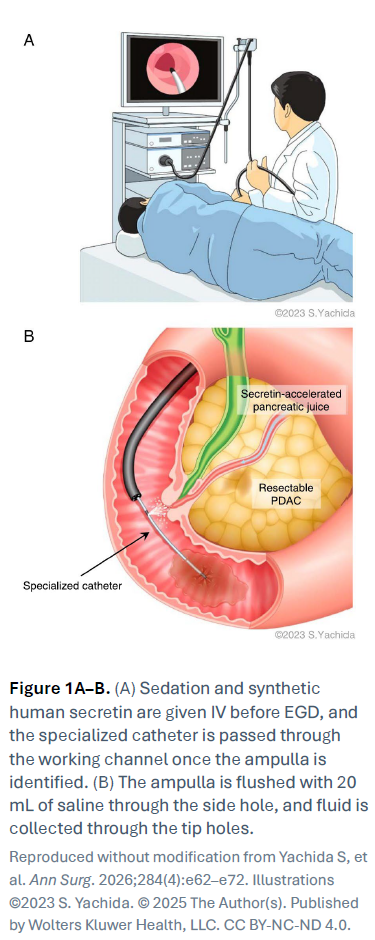
The procedure is short. The patient receives IV synthetic human secretin (0.2 µg/kg), and the endoscopist performs a routine EGD. A purpose-built catheter then flushes the ampulla with 20 mL of saline and collects the fluid, which is sent for KRAS testing (Figure 1A–B).1
The catheter design matters. A conventional contrast catheter has a single tip hole that suctions against the duodenal mucosa and blocks. The new catheter washes the papilla through a side hole 30 mm from the tip and aspirates through six tip holes, so collection continues without the catheter sticking to the wall (Figure 1C).1
Secretin is what makes this work. It neutralizes the acidic duodenal fluid, which protects tumor DNA, and it roughly doubles the volume of fluid recovered (median 17.9 mL vs 8.5 mL). Only one minor adverse event, fatigue, was reported.1
| ABOUT SECRETIN IN THIS STUDY Yachida et al. used synthetic human secretin (ChiRhoStim®) at 0.2 µg/kg IV over 1 minute before EGD.1 |
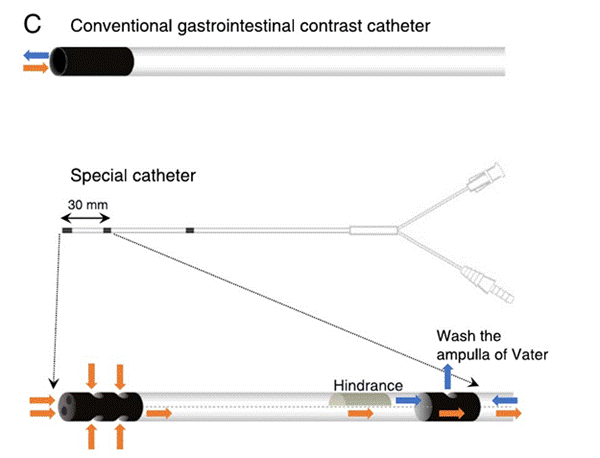
Figure 1C. A conventional contrast catheter has one tip hole, and aspiration pressure on that hole hinders collection. The specialized dual-layer catheter washes the ampulla of Vater through a side hole and collects fluid through six tip suction holes without drawing in the duodenal wall. Blue arrows show saline flow; orange arrows show fluid flow during lavage.Reproduced without modification from Yachida S, et al. Ann Surg. 2026;284(4):e62–e72. © 2025 The Author(s). Published by Wolters Kluwer Health, LLC. CC BY-NC-ND 4.0.
THE RESULTS
It finds the cancers we most want to find
Sensitivity with specificity fixed at 100% Resected PDAC vs healthy controls
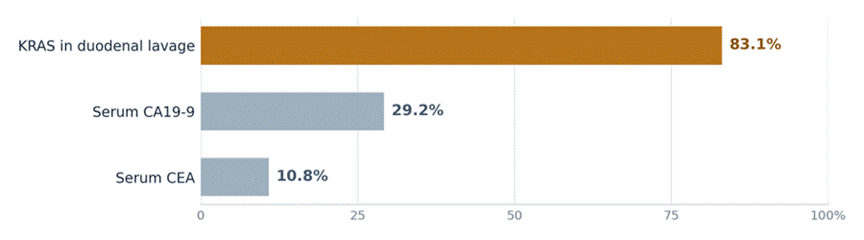
Chart drawn for this newsletter from data in Yachida et al.1 KRAS AUC 0.934 (95% CI 0.904–0.964).
- Early-stage disease: the test held up in pathologic stage 0–I cancer (AUC 0.912).1
- Tumors under 1 cm: it detected 6 of 10, in the size range where, as noted in our August issue, five-year survival approaches 60%.1
- Tail tumors: detected as well as head tumors, even though the tail sits farthest from the papilla.1
- No false alarms from common mimics: no patient with chronic or autoimmune pancreatitis tested positive.1
- IPMN: the test separated invasive IPMN from low-grade cysts, which serum markers could not do.1
“Every screening EGD could become a chance to catch pancreatic cancer while it’s still curable.”
MOMENTUM
The research is moving quickly
- Sensitivity nearly doubled compared with the group’s earlier method, which did not use secretin or the new catheter.1
- A next-generation balloon catheter has been submitted for regulatory approval in Japan.1
- A large prospective study in high-risk patients is under way to test the method in a real screening population.1
- One additional early cancer for every 270 high-risk patients screened, by the authors’ estimate.1
THE BIGGER PICTURE
Three research programs, one direction
Yachida’s team credits Johns Hopkins’ distal-cap collection of pancreatic fluid from the ampulla as a parallel effort.2 Their KRAS signal is also a natural partner for Mayo Clinic’s methylated-DNA markers in secretin-stimulated juice,3 which raises the prospect of a multi-analyte test on pancreatic juice. Researchers on three continents are now arriving at the same answer.
LOOKING AHEAD
What comes next
The cutoff still needs independent validation, and access to the catheter must expand beyond Japan. Even so, the goal is coming into focus: early pancreatic cancer detection built into the endoscopy suite. We’ll report on the high-risk cohort results as they emerge.
References
1. Yachida S, Yoshinaga S, Shiba S, et al. KRAS mutations in duodenal lavage fluid after secretin stimulation for detection of pancreatic cancer. Ann Surg. 2026;284(4):e62–e72. doi:10.1097/SLA.0000000000006645
2. Suenaga M, Sadakari Y, Almario JA, et al. Using an endoscopic distal cap to collect pancreatic fluid from the ampulla (with video). Gastrointest Endosc. 2017;86(6):1152–1156.e2.
3. Engels MML, Berger CK, Mahoney DW, et al. Multimodal pancreatic cancer detection using methylated DNA biomarkers in pancreatic juice and plasma CA 19-9: a prospective multicenter study. Clin Gastroenterol Hepatol. 2025;23:766–775.
Figure permissions. Figure 1 is reproduced, unaltered, from reference 1, an open-access article distributed under the Creative Commons Attribution-NonCommercial-NoDerivatives 4.0 License (CC BY-NC-ND 4.0; creativecommons.org/licenses/by-nc-nd/4.0). The sensitivity chart was drawn for this newsletter from data reported in reference 1.
This newsletter is an educational summary prepared for healthcare professionals in gastroenterology and pancreatology. It synthesizes findings from the peer-reviewed literature cited above and is not intended as medical advice, a treatment recommendation, or promotional labeling for any product. Diagnostic performance figures reflect the specific study populations and methods described in each source. ChiRhoStim® is a registered trademark of ChiRhoClin, Inc.